

18 New WHS Codes Have Been Released. But Most
Businesses Are Asking The Wrong Question.
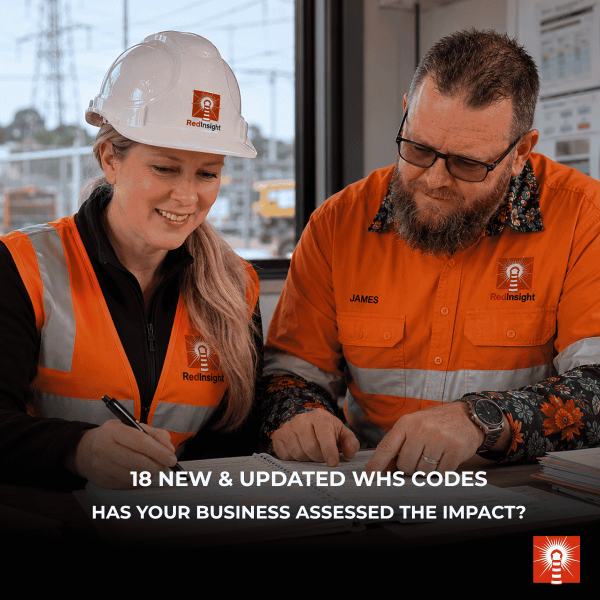
Since December 2025, SafeWork NSW has released 18 new or updated Codes of Practice, including eight updates in May alone.
For many businesses, the immediate response has been:
“What do we need to update?”
It’s a reasonable question. But it may not be the most important one.
The bigger question is: How confident are you that your safety system reflects how work is actually performed today?
Because the reality is that many of these updates are not introducing entirely new concepts.
Some are replacing guidance that has remained largely unchanged for years and, in some cases, decades. The previous Work Near Overhead Power Lines Code of Practice, for example, was last issued in 2006.
Think about that for a moment.
In the twenty years since, workplaces have changed dramatically. Technology has evolved. Workforces have changed. Contracting arrangements have changed. Regulator expectations have changed. The complexity of many work environments has increased significantly.
Smartphones were not yet commonplace. Cloud-based systems were rare. Many of today’s workplace technologies, communication platforms and digital safety tools simply did not exist.
Yet many businesses are still relying on safety systems that have evolved through minor amendments, document revisions and compliance updates rather than genuine operational review.
From 1 July 2026, organisations will be required to comply with applicable Codes of Practice or demonstrate that they have implemented an equivalent or higher standard of health and safety.
That should not trigger a rush to update documents. It should, however, trigger a much bigger conversation.
- Do your procedures reflect current work practices?
- Do your workers understand the controls they are expected to apply?
- Can supervisors consistently implement those controls under operational pressure?
- Can leaders confidently demonstrate why their controls are effective?
Too often, safety systems become administrative exercises rather than operational tools.
- Documents are reviewed. Tick.
- Policies are updated. Tick.
- Registers are completed. Tick.
Yet the actual work continues to evolve faster than the system designed to support it. This is where many organisations become exposed.
Not because they don’t care about safety. Not because they deliberately ignore requirements.
But because the system slowly drifts away from the realities of the workplace.
We see it regularly.
Businesses purchase systems that sit on a shelf.
Not because they don’t care, and often not because they made the wrong decision. Many are simply trying to balance competing priorities, limited resources and the day-to-day pressures of running a business.
The challenge is that even the best safety system provides little protection if it never makes its way into everyday work.
Procedures are copied from another organisation or generated using AI, then accepted at face value without proper consultation with the people actually performing the work.
Documents are created to satisfy a tender requirement, only to be forgotten once the contract is won. Sound familiar?
The problem is not a lack of paperwork. The problem is that paperwork alone does not control risk. The businesses best positioned for these changes are not necessarily those with the largest safety manuals or the most procedures.
They are the organisations willing to challenge themselves honestly.
- Where are our highest risks?
- Are our controls still effective?
- Do we have gaps between documented work and real work?
- Are we focusing our effort where serious harm is most likely to occur?
- Do our workers genuinely understand what is expected of them?
- Can we demonstrate that our controls are practical, effective and consistently applied?
The release of 18 new and updated Codes of Practice is important.
But perhaps the greatest value of these changes is the opportunity they provide organisations to stop, reassess and ensure their safety systems remain relevant to the realities of modern work.
Because compliance has never been the goal. The goal is to ensure people go home safely while work continues to get done.
That requires systems that reflect reality, leaders who genuinely own safety, and the willingness to challenge whether what is written on paper still works in practice.
Updating paperwork is easy.
Maintaining relevance is the real challenge.
If you’re unsure how these changes impact your business, your WHS Management System or your existing procedures, now is the time to find out.
A practical review today is far easier than explaining the gap tomorrow.
#redinsightau